handbookcalcs.com CA calculators

Calculator CA1 ยท Renewal Shock. The Canadian Mortgage Handbook

Your renewal number

Put in your balance, your remaining amortization, the rate you're on now and the rate you've been offered. It gives you the new payment, the increase in dollars and per cent, what it costs over a full five-year term, and what each quarter point is worth on your balance.

Nothing you type here leaves your phone. We don't store it and we can't see it. The math runs on your device.

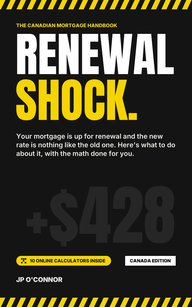
Cover of Renewal Shock. The Canadian Mortgage Handbook

This calculator goes with Renewal Shock. The Canadian Mortgage Handbook by JP O'Connor. The book explains what the numbers mean and what to do next.

$
yrs
%
%
$
yrs

How the payment is worked out. Canadian fixed-rate mortgages compound semi-annually, not monthly. The monthly rate used here is (1 + annual rate รท 2) to the power of one sixth, minus one โ€” the method set out in chapter 4 of the book. Variable-rate mortgages compound monthly, and this calculator uses annual rate รท 12 wherever a variable rate is entered. A calculator built for an American or British mortgage uses the monthly method for everything and will give you the wrong payment for a Canadian fixed mortgage.

Any rate already filled in is as at September 2026 โ€” Bank of Canada policy rate 2.25%, prime 4.45% at the six major banks, posted five-year 6.09%, best available five-year fixed about 4.24%. Rates move weekly and fixed rates move with the five-year Government of Canada bond yield, sometimes daily. Check yours before you rely on any of this.

General information, not financial advice. This is math on the numbers you type. Nothing you enter is stored, saved or sent anywhere โ€” there is no account and no cookie, and your numbers never leave this page. All figures are Canadian dollars (CAD). Check your own numbers with your lender or a licensed mortgage broker.

Why a Canadian mortgage does this at all

A Canadian mortgage has an amortization, which is how long until it is paid off, usually 25 years, and a term, which is how long the current contract lasts, usually five years or less. At the end of the term the loan does not end. It is renewed at whatever rates exist that week. That is why a rate move reaches every Canadian borrower on a schedule, a cohort at a time, whether or not they moved house, refinanced or did anything at all.

The semi-annual thing, and why it matters here

Canadian fixed-rate mortgages compound semi-annually, not in advance. The monthly rate is the sixth root of one plus half the annual rate, minus one. At 2.20% that is a monthly factor of about 0.001824, not 0.001833. On a $500,000 mortgage the difference between the two methods is a couple of dollars a month, which sounds trivial until it compounds over 300 payments and changes your balance at renewal. Variable-rate mortgages compound monthly, so this calculator switches method when you tell it the new rate is variable.

What the book's worked household looks like

They borrowed $500,000 in September 2021 on a five-year fixed at 2.20% over 25 years. The payment was $2,166. After 60 payments the balance was $420,605. Renewing at 4.24% over the 20 years left gives $2,594 โ€” an increase of $428 a month, or 19.8%. That cross-checks against the Bank of Canada's "about 20%" for five-year fixed renewals in 2026, which is reassuring, because it means the example is not an outlier chosen to frighten anyone.

Scaling it, roughly

The increase scales roughly with the balance. Going from 2.20% to 4.24% over 20 years is about +$205 a month on $200,000, +$305 on $300,000, +$428 on $420,000, +$610 on $600,000 and +$815 on $800,000. Those are for orientation only. Use your own remaining amortization, because it changes the answer as much as the balance does.

Then make the number smaller

In rough order of how much they are worth: get a better rate (worth $50 to $400 a month), extend the amortization (a real lever with a large, knowable price), clear expensive debt elsewhere (often the biggest number in the household), and ask your lender for relief if you are genuinely in difficulty. Do them in that order, and do the first one before you sign anything.
Check this one. Your renewal statement is the authority on your balance, your rate, your payment frequency and your renewal date, and a federally regulated lender must send it at least 21 days before renewal. Your payment may not be monthly โ€” biweekly and accelerated biweekly are common, and an accelerated schedule pays more per year than this monthly figure. Ask your lender for your amortization schedule if the payment here doesn't match yours.

Get the full handbook

Cover of Renewal Shock. The Canadian Mortgage Handbook

Canada · 170 pages · JP O'Connor

Renewal Shock.

The Canadian Mortgage Handbook

The rule that kept you with your lender changed in 2024. Nobody told you.

  • Uninsured straight switches no longer face the stress test (since November 21, 2024)
  • Why the posted rate you never paid drives your prepayment penalty
  • Your trigger rate: how to find it and what happens when you reach it
  • Prepayment room that's gone on the reset date if you don't use it

The other calculators